
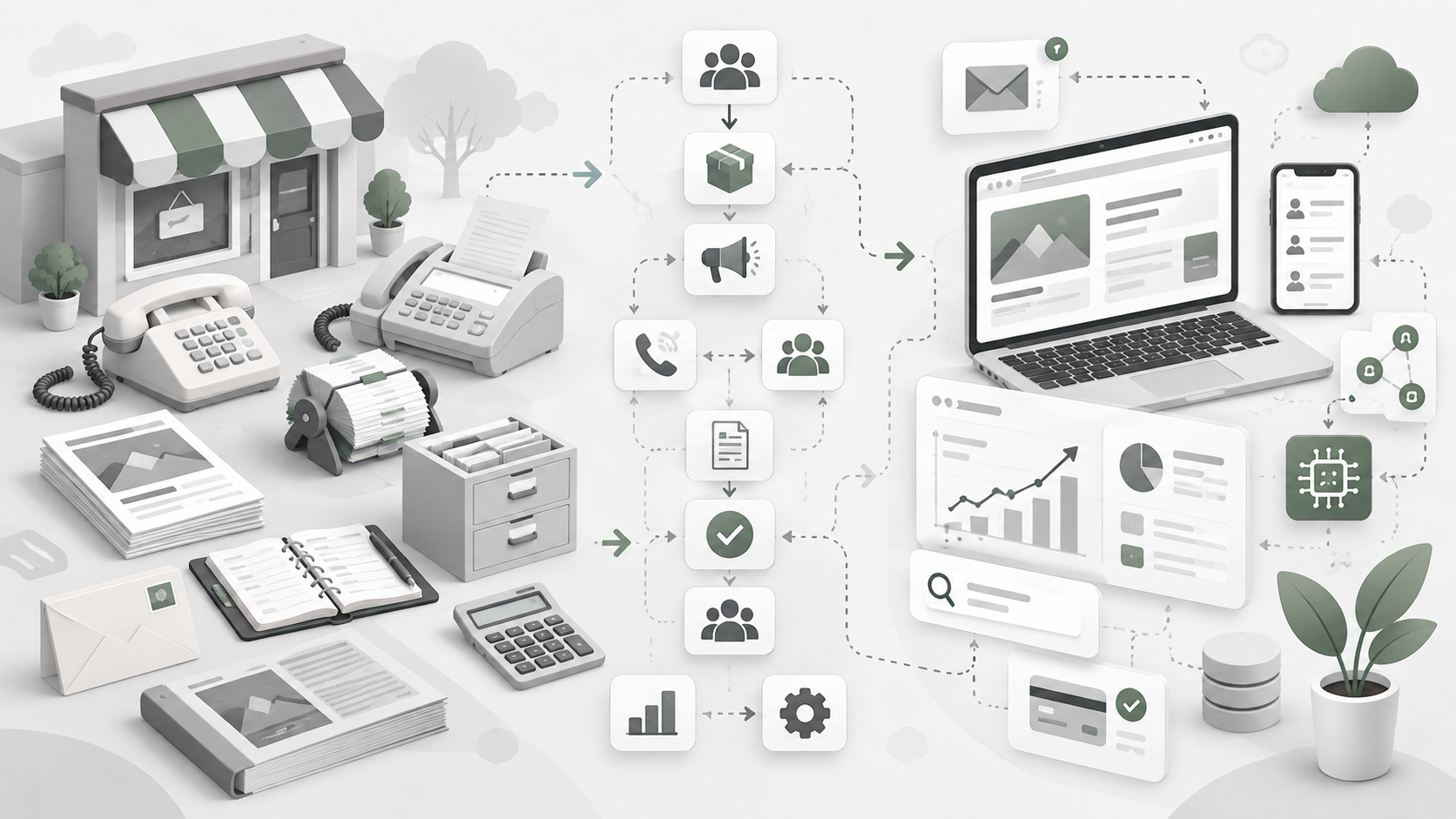
Imagine it is 1990.
There is no Google. No website. No email marketing. No social media. No Stripe. No CRM in the modern sense. No analytics dashboard showing where every lead came from.
You are starting an SME.
So what does the business actually look like, and what does starting an SME in 1990 teach us about go to market today?
The short answer is that the tools and technology have changed completely, but the core commercial process is still much the same.
You still need to identify a market, develop an offer, build the business infrastructure, create awareness, find prospects, convert them into customers, measure what works, and improve the system over time.
That makes the comparison useful for entrepreneurs, SME owners, and business strategists: it strips away today’s software stack and shows which parts of go-to-market are fundamental rather than fashionable.
What follows looks at how those jobs were handled in 1990 across strategy, infrastructure, marketing, outreach, analysis, and integration, and then maps them to their modern digital equivalents.
In other words, the technology changes.
The fundamentals do not.
STRATEGY: Decide Who You Serve and Why They Should Buy
A business in 1990 still started with essentially the same questions we ask today.
Who is the customer?
What problem are we solving?
Why should they buy from us rather than someone else?
The difference was how you found the answers, because starting a small business in 1990 meant working in an analogue world while also beginning to navigate an early digital transition.
Market research might involve visiting the local library, reading trade magazines, buying industry reports, studying the Yellow Pages, looking through business directories, speaking to suppliers and talking directly to potential customers. More formal research often meant expensive focus groups and slow surveys.
You might physically visit competitors.
You might telephone companies and ask questions.
And for many SMEs, geography played a much bigger role.
A business based in Bridgend might primarily think in terms of customers across South Wales rather than instantly considering the whole UK, Europe or the world. Many small and medium-sized businesses had to focus tightly on a local niche first, using that focus as the plan before expanding into a new market.
A basic positioning statement might have been:
We provide X to businesses in Y area because we can deliver it faster, better or more reliably than the alternatives.
That sounds remarkably similar to positioning today.
BUILD: Create the Business Infrastructure
Once the proposition was established, you needed to build the business around it.
A typical SME infrastructure in 1990 might include:
- an office, shop or workshop
- a landline
- an answering machine
- a fax machine
- filing cabinets
- a Rolodex
- a diary
- a photocopier
- a printer
- accounting software
- possibly an early customer database
- plenty of paper
The physical assets of the business performed many of the jobs now handled by digital systems.
Many firms had to bootstrap carefully, managing money and resources closely because early infrastructure spend affected the balance sheet, reinforced revenue discipline, and shaped business growth.
A shop or office gave you presence.
A printed brochure explained your services and, along with in-person demonstration, reduced adoption friction by making the offer easy to understand.
A catalogue displayed your products.
The Yellow Pages helped people discover you.
A Rolodex stored contacts.
Paper customer records acted as a primitive CRM.
An order book managed transactions.
Printed newsletters maintained customer relationships.
Cheque, cash and card terminals handled payment.
The underlying business functions already existed.
We have simply digitised them.
MARKET: Make People Aware You Exist
Marketing in 1990 meant buying access to attention.
There were plenty of channels available, but none had the targeting, speed or measurability we take for granted today.
A typical SME might use:
- Yellow Pages advertising
- local newspapers
- trade magazines
- direct mail
- radio
- posters
- leaflets
- sponsorships
- exhibitions
- industry directories
- vehicle signage
For many local SMEs, the real value of marketing was often in building trust and credibility rather than simply generating visibility.
For many businesses, a fairly standard marketing mix could have been:
Yellow Pages + local advertising + brochures + direct mail + referrals, with word-of-mouth and community-first distribution through local business networks and rotary clubs often carrying the same importance as paid placement.
And there was a major difference compared with digital marketing today.
Campaigns were much harder to change.
If you placed a large Yellow Pages advert and it performed badly, you could not log into a dashboard the next morning and rewrite it.
You might be looking at the same advert for the next year.
Reputation was critical, because a small business often won customers through trust before any brand building had created wider brand recognition.
Marketing therefore required a greater commitment to decisions before publishing them.
OUTREACH: Go and Find Customers
This is perhaps where 1990 looks most different from the inbound-heavy digital world that followed.
Businesses actively went looking for customers, and for many local founders this was the main growth engine because networks and introductions helped them reach SMEs and get in front of real customers.
A B2B company might build or purchase a prospect list and then follow a process like this:
Introductory letter → telephone call → follow-up call → meeting → presentation → written quotation → further follow-up → sale.
High-touch selling worked by building trust through conversations and meetings, not by relying on a long automated funnel.
Salespeople carried business cards, brochures, price lists, catalogues, diaries and order forms.
They drove to customer premises.
Networking happened through:
- chambers of commerce
- trade associations
- breakfast meetings
- conferences
- exhibitions
- business clubs
- personal introductions
Many firms also entered the market incrementally, using early meetings to test purchasing decisions, refine the offer, and improve their chances of success, often with local partners or institutions providing support along the way.
What we now call outbound sales, lead generation or prospecting was simply called selling.
And it was often central to the company’s growth. These direct conversations helped test product-market fit with real customers before scaling outreach.
ANALYSE: Work Out What Produces Business
Analytics existed.
They were simply less sophisticated.
One of the most important questions a business could ask was:
How did you hear about us?
The answer might then be recorded as:
- Yellow Pages
- newspaper advert
- referral
- salesperson
- exhibition
- direct mail
- passing trade
Businesses could also calculate conversion funnels.
For example:
1,000 letters sent
→ 50 enquiries
→ 20 meetings
→ 7 customers
That is essentially the same funnel analysis marketers perform today. Smaller firms could often respond quickly to market feedback at this point and adjust faster than larger competitors.
The major difference is that the data might arrive over weeks or months rather than appearing on a dashboard within seconds.
Performance reviews were often monthly or quarterly and based on sales reports, accounts, enquiry logs and spreadsheets. The point was to track clear objectives and avoid wasted time on activity that was not moving the business forward. Direct deployments and customer conversations also created iterative feedback loops that improved the offer over time.
Less data perhaps, but often very commercially focused data.
INTEGRATE: Turn the Business Into a System
As the company grew, processes became more important.
Imagine a typical sales process:
Advert
→ customer telephones
→ receptionist records enquiry
→ salesperson follows up
→ meeting arranged
→ quotation prepared
→ order received
→ product or service delivered
→ invoice raised
→ payment received
→ customer record updated
→ future marketing
That is a business workflow.
Today we might connect WordPress, a CRM, Stripe, an email platform and n8n to achieve exactly the same thing, but the goal is not more tools; it is a better solution that improves customer value and operational efficiency.
In 1990, humans, paper and telephones connected the systems instead.
The workflow still existed.
Any technology choice, including artificial intelligence, should address a real workflow problem rather than be adopted for its own sake.
It was simply manual.
What Did a 1990 Go-to-Market Strategy Actually Look Like?
Imagine you started an office-equipment company in 1990.
You sell photocopiers, fax machines and servicing contracts to local businesses.
Your strategy might look something like this.
Target market
Small and medium-sized enterprises, including medium sized enterprises employing between 10 and 100 people within 50 miles of your office; many local SMEs start with that tight geographic focus before expanding.
Offer
Office equipment supplied and maintained locally.
Positioning
A reliable local supplier capable of providing rapid servicing when equipment fails.
Customer acquisition
Yellow Pages advertising
→ business directory research
→ introductory letters
→ cold calling
→ sales appointment
→ equipment demonstration
→ written quotation
→ follow-up
→ sale
Then the relationship continues:
Customer
→ servicing contract
→ repeat purchases
→ referrals
That is a complete go-to-market engine.
No website required.
The Technology Changed. The Business Didn’t.
This is the most interesting part.
Strip away the technology and businesses are still performing the same fundamental activities.
They need to:
identify a market
→ develop an offer
→ establish a presence
→ create awareness
→ find prospects
→ convert customers
→ fulfil the promise
→ retain customers
→ measure results
→ improve the system
In 1990, the infrastructure might have looked like this:
Strategy → office → brochure → advertising → telephone → salesperson → sale
By the 2020s, it became:
Strategy → website → content/ads → search/social → CRM → automation → sales → Stripe
And the next stage increasingly looks like:
Strategy → digital infrastructure → automated workflows → AI agents → human oversight
The channels keep changing.
The tools keep changing.
A clear go to market strategy also helps startups attract better funding terms because investors can see how the business plans to win customers, while a marketing strategy is the ongoing plan used after product-market fit to sustain growth.
The speed keeps increasing.
But the commercial architecture underneath remains surprisingly stable.
Six Business Functions That Survive Every Technology Shift
A useful way of looking at any SME is through six connected activities: for uk smes, which make up 99.9% of businesses and generate 60.6% of private sector employment, getting these fundamentals right matters for economic growth.
STRATEGY
Decide what market to enter, who to serve, what to offer and how to position the business, which means setting clear objectives and a tactical plan when entering a new market.
BUILD
Create the infrastructure needed to deliver the proposition, aligning spend and resources with the aim of supporting long term growth rather than just launching quickly.
MARKET
Generate awareness and demand.
OUTREACH
Actively identify and engage potential customers.
ANALYSE
Measure what is working and what is not.
INTEGRATE
Connect the business processes so the organisation operates efficiently.
Those six functions would have made sense in 1990.
They make sense today.
And they will probably still make sense when large parts of the SME are operated by AI.
That is because technology does not remove the fundamentals of business.
It changes how efficiently we execute them.
The lesson from 1990 is therefore not that modern SMEs are completely different.
It is almost the opposite.
Business remains remarkably consistent.
What changes is the machinery around it.