
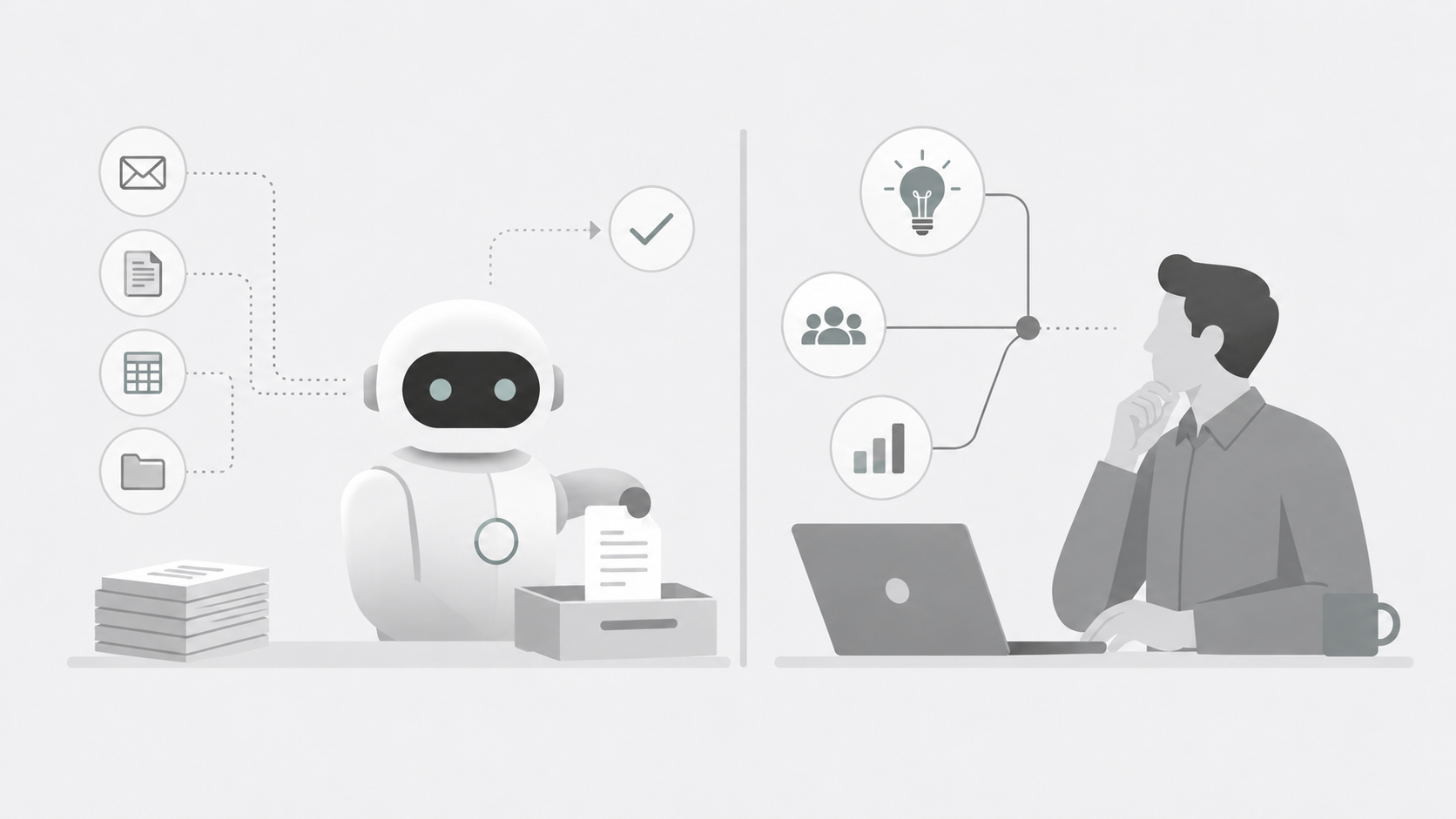
The strongest practical case for AI is not that it will replace every professional.
It is that it will remove an enormous amount of digital busywork.
This is the repetitive, administrative and low-judgement work that consumes hours without creating much direct value:
- copying information between systems;
- compiling routine reports;
- formatting documents;
- transcribing meetings;
- tagging enquiries;
- updating CRM records;
- checking dashboards;
- scheduling approved content;
- summarising long documents;
- repurposing material;
- chasing missing information.
These tasks are necessary, but they are often exhausting, repetitive and poorly suited to human attention.
AI and automation are increasingly good at them.
The work moves upwards
When the administrative layer shrinks, the human role does not necessarily disappear.
It moves towards work that requires:
- diagnosis;
- prioritisation;
- interpretation;
- customer understanding;
- strategic choice;
- taste;
- relationships;
- accountability.
In the future of work, AI tends to reshape human jobs rather than erase them, shifting jobs away from admin and toward judgment.
The marketer may spend less time manually assembling a report and more time deciding what the report means, which gives workers more space for strategic thinking and higher value work.
They may spend less time producing a first draft and more time determining whether the subject is worth writing about, where creativity still matters.
They may spend less time updating contact records and more time understanding why opportunities are not converting.
This is not the removal of work. It is the removal of lower-value effort from the working day, and a reminder that the future depends on protecting the parts of human work that require judgment.
Production capacity is not human judgment
AI can produce options rapidly.
It can draft ten headlines, analyse a website, summarise competitors, synthesise data and suggest campaign ideas.
But as workers shift into human jobs that depend on decision making rather than repetition, AI does not automatically know:
- which problem matters most;
- what the client can realistically afford;
- whether the evidence is reliable;
- what the customer genuinely cares about;
- whether the timing is wrong;
- whether the business should avoid the campaign entirely;
- when strategic thinking should override the obvious option;
- how creativity and critical thinking change the brief.
Those decisions involve context, consequences and human insight.
The person making them remains responsible for what happens next, especially in high level decision making where judgment, human judgment and complex decision making still matter most.
The danger of the approval-button model and AI replacing jobs
Some AI platforms reduce human involvement to the final stage.
The system conducts the research, chooses the subject, creates the content and prepares it for publication. The human is then invited to click approve or reject.
This appears efficient, but many organizations and most organizations still treat AI as a productivity tool in ways that move the human too far downstream.
By the time they see the final output, many of the important decisions have already been made:
- the objective;
- the angle;
- the assumptions;
- the sources;
- the audience;
- the proposed action.
The human becomes an editor rather than a strategist, and leaders lose visibility into how judgment is being applied.
A stronger human-in-the-loop system involves the person at the beginning:
- The human defines the business objective.
- AI assists with research and production, using AI to synthesize large volumes of data to support decision making.
- Automation handles stable, repeatable steps.
- The human evaluates meaning, risk and commercial value with human insight.
Those decisions involve context, consequences and human judgment in complex decision making. AI enhances decision-making by synthesizing vast amounts of data, but it is designed to complement human oversight and critical thinking. 96% of business leaders believe AI improves decision quality, while the person making the call remains responsible.
That is very different from asking AI to run the department and involving the person only at publishing time. It is a better model for organizations, teams and leadership, especially when many leaders use AI as a strategic tool rather than letting it replace accountability.
Why capable people with critical thinking may become more valuable
As AI makes competent production widely available, producing something becomes less impressive.
The scarce capability becomes deciding what deserves to exist.
Generic content will become abundant. Original experience, customer insight, proprietary evidence and strong commercial judgement will remain scarce.
The competitive advantage shifts from:
Who can produce this?
to:
Who can determine what is worth producing and why?
This is why AI may make experienced operators more valuable rather than less.
A capable person can use the technology to increase their reach and remove unnecessary effort, and AI improves their ability to filter weak ideas before they spread.
A weak operator can use the same tools to create more weak material at greater speed.
That is why leadership, emotional intelligence, and human experience still matter if teams want to reach their full potential.
AI amplifies the person directing it.
The best use of saved time with AI tools
The worst response to automation is to fill the hours it can save time with more activity:
- more articles;
- more posts;
- more emails;
- more reports;
- more outreach.
That simply replaces manual overload with automated noise and leaves little room for focus.
The real opportunity is to remove unnecessary work entirely and help employees work smarter, then redirect human attention towards:
- customers;
- offers;
- strategy;
- improvement;
- problem solving;
- relationships.
That shift also reduces anxiety about job loss, because the point is better allocation of effort, not replacement. It also pushes teams to build ai skills and new skills that make human ai collaboration more effective.
The strongest principle is therefore simple:
The scarce ability becomes judging what matters and what deserves to exist.
Original experience, customer insight, proprietary evidence and strong commercial judgement will remain scarce. AI amplifies human skills like creativity and emotional intelligence, but does not replace human experience.
A capable person can use the technology to reach their full potential, and AI improves how far their judgement can travel while removing unnecessary effort.
A weak operator can use the same tools to produce more weak ideas at greater speed.
AI should remove the work that drains human attention, not remove humans from the decisions that require it.
AI amplifies the person directing it. Artificial intelligence acts as a force multiplier by handling mundane tasks.