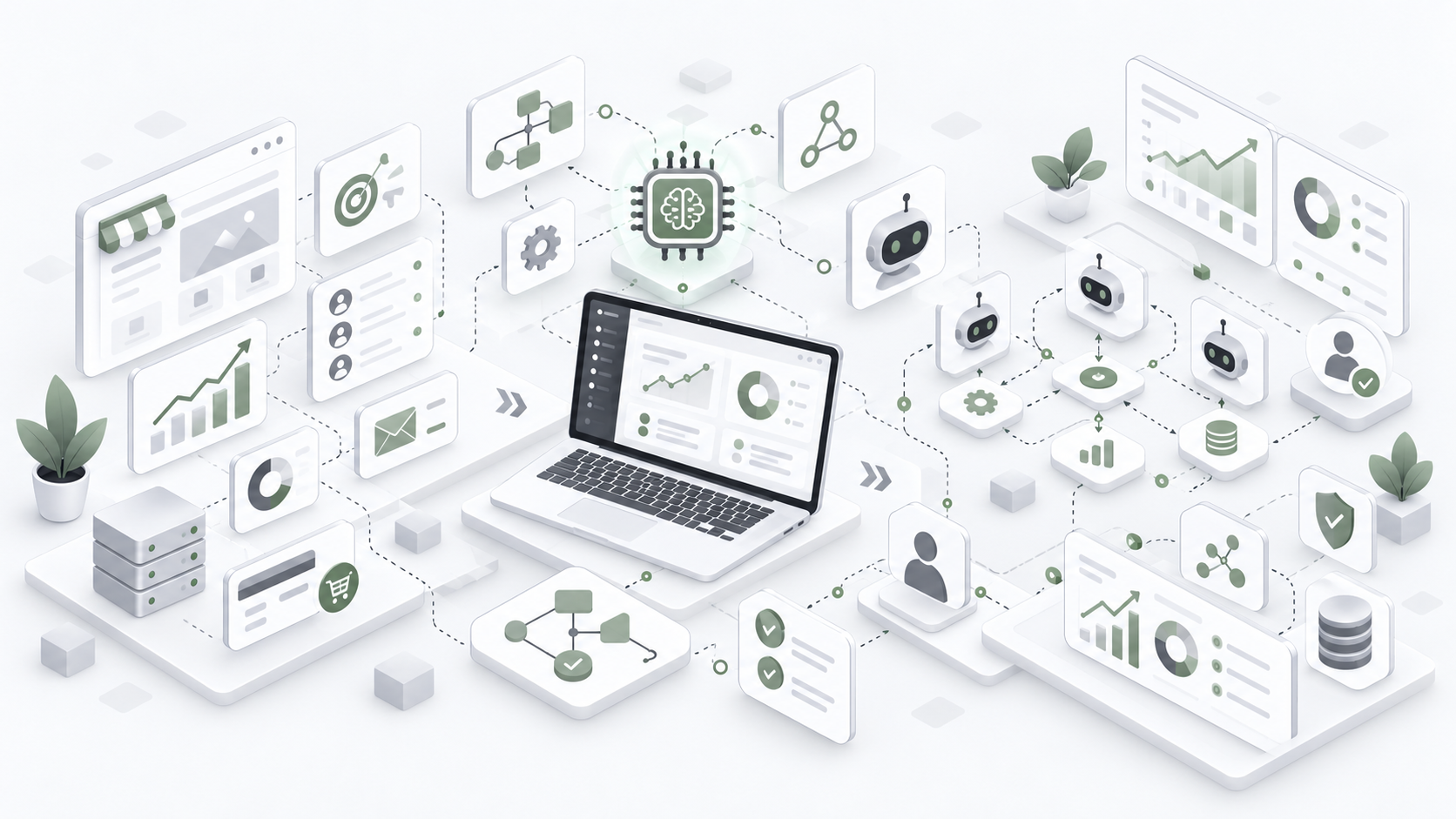
A much clearer strategic picture has emerged around the future of digital business, SME growth and AI-enabled operations: how businesses move from digital growth to AI-operated businesses by layering intelligence and automation over the digital systems they already run, then progressing from strategy and build to automation, agent delegation, multi-agent orchestration and human governance.
What began as a fairly conventional digital-growth model for SMEs – strategy, websites, marketing, outreach, analytics and integration – increasingly reveals itself as something broader: a framework for helping small and medium-sized enterprises, digital strategists, AI practitioners and digital-growth teams evolve from ordinary digital operations into increasingly automated, AI-assisted and eventually agent-operated organisations.
The central idea is simple.
Businesses still need the same fundamentals they needed before generative AI became mainstream. They need a viable offer, a clear target market, a website, a way to generate demand, a sales process, customer records, payment infrastructure, email, analytics, operational systems and reliable data.
AI does not remove those requirements.
Instead, AI creates a new intelligence and automation overlay above the existing digital business stack, which is why this shift matters to any business already investing in digital growth: it increases efficiency, scale and operating leverage without removing the need for human judgement, control and strategic oversight.
A business can therefore develop in stages:
Strategy → Build → Market → Outreach → Analyse → Integrate
and then increasingly:
Systemise → Automate → Assist → Delegate → Orchestrate → Govern
The most important conclusion is that the existing six-part framework is not becoming obsolete because of AI.
It is becoming more relevant.
The technology stack now also has a clearer layered structure:
- Agent OS / Mission Control as an optional visual control layer.
- Hermes for the personal-agent layer.
- n8n for workflow automation and integration.
- PydanticAI for specialist custom agents.
- LangGraph for complex stateful and multi-agent systems.
- LangSmith / Logfire for tracing, evaluation, observability and debugging.
- Python as the primary programming language underneath the agent layer.
- APIs, webhooks and MCP as the communication layer.
- Postgres/Supabase as persistent operational memory and shared state.
- Existing platforms such as WordPress, Stripe, CRM systems, email platforms and analytics tools as the underlying business infrastructure.
The important distinction is that this is an overlay technology stack.
The goal is not to replace the existing digital business stack.
The goal is to build intelligence, process automation, observability and agent coordination on top of it.
Together these components point toward something considerably more interesting than simply becoming an “AI consultant”.
They point toward an AI-native digital growth model in which conventional digital-business expertise, automation, software integration and agentic systems combine into a single discipline.
1. The Fundamental Insight: Build the Business First
One of the most important realisations is that an AI-operated business does not begin with agents.
It begins almost exactly as an online business might have begun in 2020.
You still need:
- an offer,
- positioning,
- customers,
- a website,
- products or services,
- payment processing,
- email,
- customer records,
- analytics,
- content,
- operational processes,
- reliable data.
Consider a simple digital-product business.
Its conventional architecture might be:
WordPress → Stripe → CRM → Email → Analytics → Database
There is nothing particularly futuristic about that.
The change comes when automation and intelligence are layered above it.
The architecture starts becoming:
Business infrastructure → automation → specialist intelligence → agent orchestration → owner control
This distinction matters enormously.
Many people approaching AI effectively start at the wrong end.
They ask:
What agent should I build?
A better question is:
What business process already exists, and where would automation or intelligence create measurable value?
That keeps the technology subordinate to the commercial objective.
A poorly designed business does not become a good business because ten agents have been attached to it.
A good digital business, however, can potentially become dramatically more efficient when repetitive work, analysis, coordination and defined decisions are progressively delegated to software.
2. The Six-Part Digital Growth Model
The framework:
Strategy
Build
Market
Outreach
Analyse
Integrate
is more significant than it initially appears.
It is not merely a list of digital services.
It describes the development sequence of a functioning digital business.
The order matters.
You first determine what should exist.
Then you build it.
Then you generate demand.
Then you actively create opportunities.
Then you measure what happens.
Then you connect and improve the system.
And once integration is in place, the cycle begins again with better information.
3. Strategy: Decide What Should Exist
Everything starts with Strategy.
Before building websites, automations or agents, somebody must determine:
- What are we selling?
- Who is it for?
- What problem does it solve?
- Why would someone choose it?
- What should it cost?
- What does commercial success look like?
- Where is the biggest growth constraint?
- What should happen next?
This becomes even more important in an AI-rich environment.
AI dramatically reduces the cost of producing things.
It can help create:
- websites,
- articles,
- emails,
- research,
- software,
- workflows,
- campaigns,
- landing pages,
- reports,
- agents,
- internal tools.
Consequently, the scarce resource increasingly becomes judgement rather than production.
If everybody can produce more, deciding what deserves to be produced becomes more valuable.
This makes Strategy an appropriate first pillar.
AI may participate in strategic analysis, and AI technologies can inform growth strategies, but strategic direction still requires context, commercial judgement, priorities, constraints and human ownership.
4. Build: Create the Digital Business Infrastructure
Once the strategy is established, the organisation needs an operating environment.
This is the Build layer.
Traditionally that might mean:
- WordPress,
- WooCommerce,
- landing pages,
- forms,
- databases,
- product pages,
- checkout systems,
- CRM implementation,
- analytics instrumentation.
In an AI-native business, Build expands.
It can also include:
- API architecture,
- structured databases,
- authentication,
- webhook endpoints,
- internal tools,
- agent interfaces,
- data pipelines,
- machine-readable business state.
But the principle remains unchanged.
Build creates the environment in which the business can operate.
A website increasingly becomes more than the visible front end of a company.
It can become the entry point into a wider digital system.
A lead form, for example, can trigger:
Form → n8n → enrichment → CRM → scoring → AI analysis → follow-up → reporting
The visible website becomes only the front edge of a much larger business machine.
5. Market: Generate Demand
Once the infrastructure exists, the business needs attention.
That remains the job of Market, where AI can strengthen marketing efforts and help attract new customers.
This includes familiar disciplines such as:
- SEO,
- content,
- paid search,
- paid social,
- email marketing,
- social media,
- local visibility,
- AI-search visibility,
- remarketing.
AI changes how these activities are executed but does not eliminate their purpose, and that shift can support business growth; in fact, 91% of small businesses report enhanced success due to AI.
A business still needs people to:
discover → understand → trust → consider → buy
The difference is that parts of the marketing operation can now become intelligent systems, including content creation where generative AI can automatically produce varied visuals and messages for campaigns, enhancing customer engagement with content shaped by past interactions.
For example:
Analytics detects a ranking opportunity
↓
SEO agent investigates
↓
Research agent gathers evidence
↓
Content agent prepares a draft
↓
Editor agent checks quality
↓
Human approves
↓
n8n sends approved content to WordPress
↓
Performance feeds back into analytics
That is no longer simply content marketing.
It is a marketing operating loop that can unlock growth as performance data continuously improves campaigns.
6. Outreach: Create Demand Proactively
Market captures people who encounter the business.
Outreach deliberately goes looking for them.
This is why Outreach deserves to remain a separate discipline.
It includes:
- prospect identification,
- enrichment,
- CRM,
- account research,
- lead scoring,
- personalised communication,
- follow-up,
- pipeline management.
This is particularly fertile territory for automation and AI, and leveraging AI helps businesses operate with fewer resources while still scaling proactive outreach and helping smaller teams streamline operations.
A future SME workflow could look like:
Target account identified
↓
n8n gathers company data
↓
PydanticAI agent evaluates fit
↓
CRM receives structured lead score
↓
Research agent identifies a relevant commercial issue
↓
Outreach agent prepares a personalised message
↓
Human approval
↓
Email sent
↓
Response classified automatically
↓
CRM updated
For small businesses, AI-powered chatbots can provide 24/7 first-response handling and lead qualification; AI driven chatbots also support exceptional customer experiences and help customer service teams focus on more complex conversations after handoff.
The important point is that AI is not simply sending random emails.
The system has:
- rules,
- state,
- approval thresholds,
- structured data,
- defined objectives.
That is significantly more valuable than uncontrolled automation.
7. Analyse: Give the Business Eyes
Analyse may eventually become one of the most strategically important layers.
Without measurement, an automated business becomes an automated guessing machine.
Analytics therefore becomes the sensory system of the organisation.
Historically, analytics tools mostly produced dashboards for humans. Increasingly, AI-driven data analysis can also help small businesses interpret market trends and customer behaviors, not just historical reports.
Increasingly, that data can become machine-readable input for agents.
Instead of somebody manually checking multiple dashboards every morning, a workflow can collect:
- revenue,
- traffic,
- rankings,
- conversions,
- email performance,
- leads,
- refunds,
- support volume,
- campaign performance,
- operational failures.
AI models can process large datasets and massive volumes of real-time behavioral data instantly to produce actionable insights and support enhanced decision-making.
An Analysis Agent can then ask:
What changed?
Why might it have changed?
Is the change meaningful for decision making?
What requires attention?
What should we test next?
This moves analytics from passive reporting toward active business intelligence, where predictive analytics enhances decision-making through real-time data analysis and helps anticipate future outcomes rather than only explain past performance.
8. Integrate: Connect Everything Together
Integrate is where the various pieces become a system.
This is where n8n becomes extremely important.
Integration is no longer simply:
Connect one SaaS platform to another.
It becomes the operational nervous system connecting the digital organisation, helping existing workflows run with less friction across tools.
n8n can sit between:
- websites,
- CRM,
- Stripe,
- databases,
- analytics,
- email,
- AI APIs,
- agents,
- SaaS tools,
- internal systems.
Importantly, its function is often deterministic rather than intelligent.
For example:
Stripe says payment successful
↓
n8n provisions access
↓
CRM updated
↓
Database updated
↓
Welcome email sent
There is no reason an AI agent should decide whether those steps happen.
They should happen because the business rules say they happen.
This distinction is fundamental:
Automate what is deterministic.
Use AI where judgement is required.
That principle prevents “agentification” for its own sake.
9. n8n as the Automation Home Base
There are many workflow and automation platforms.
The objective is not to become equally expert in all of them.
For this architecture, n8n provides a particularly useful intersection between:
automation + APIs + code + AI + self-hosting + agents, and AI workflow tools can save users up to 10 hours a month.
That makes it a strong candidate for the automation home base, because the right tools can accelerate AI adoption for teams learning to adopt AI in practical stages.
The learning progression is roughly:
nodes → data structures → expressions → APIs → authentication → webhooks → JavaScript/Python → databases → error handling → AI nodes → agents
The most transferable abilities are not knowing where the buttons are.
They are:
- understanding APIs,
- designing processes to automate tasks and handle repetitive tasks while reducing human error in manual handoffs,
- handling state,
- structuring data,
- managing failure,
- creating reliable integrations that help systems perform tasks with less human error.
Those skills survive platform changes.
10. The Personal Agent Layer: Hermes
Hermes occupies a different position.
It is not principally the workflow engine.
It is the potential personal operating agent.
The distinction is useful:
n8n knows processes.
Hermes knows the owner.
Over time, a personal agent can potentially understand:
- projects,
- preferences,
- notes,
- priorities,
- recurring decisions,
- working methods,
- tools,
- business interests,
- ongoing context.
Conceptually, Hermes therefore sits above many of the professional systems.
The owner communicates with Hermes.
Hermes can then initiate actions through workflows and specialist agents.
For example:
Review all my digital businesses and tell me which needs attention today.
That request could eventually trigger:
Hermes
↓
n8n collects business data
↓
Agents analyse each business
↓
Results returned
↓
Hermes presents prioritised recommendations
Hermes therefore acts as a form of personal intelligence and conversational control plane.
11. Agent OS / Mission Control: The Visual Control Layer
This introduces another useful layer: Agent OS, or what might more accurately be described as a Mission Control interface.
Agent OS should not be confused with Hermes, n8n, PydanticAI or LangGraph.
It performs a different role.
It is the visual operational layer through which the human owner can see and control the AI-enabled business system.
Conceptually:
OWNER
  ↓
AGENT OS / MISSION CONTROL
  ↓
HERMES
  ↓
n8n / PydanticAI / LangGraph
  ↓
Business systems and data
A Mission Control dashboard might eventually show:
- current conversations with Hermes,
- agent tasks,
- workflows currently running,
- completed jobs,
- approvals awaiting action,
- failed workflows,
- LangGraph runs,
- PydanticAI outputs,
- business KPIs,
- model usage,
- API costs,
- recent system errors,
- customer issues,
- business priorities.
This becomes particularly useful once several agents and systems are operating simultaneously.
Without a control layer, the architecture risks becoming fragmented.
You might otherwise have to inspect:
- n8n,
- LangSmith,
- Logfire,
- CRM,
- analytics,
- databases,
- Hermes,
- WordPress,
- Stripe
separately.
Mission Control provides a potential single operational view above those systems.
This does not mean Agent OS becomes mandatory.
It is an optional layer.
Initially, the individual interfaces may be perfectly sufficient.
But as the overall environment expands, a unified Mission Control layer may become increasingly valuable.
12. Custom Agents: PydanticAI
PydanticAI fits naturally as the specialist-worker layer.
Rather than constructing enormous general-purpose agents, the system can contain focused components.
Examples might include:
Lead Evaluation Agent
Input:
company information.
Output:
structured lead score and explanation.
SEO Opportunity Agent
Input:
rankings and search data.
Output:
prioritised optimisation opportunities.
Customer Support Classifier
Input:
incoming customer message.
Output:
topic, urgency, confidence and route.
Product Research Agent
Input:
market/problem brief.
Output:
structured research findings.
The important concept is that these agents do not merely generate paragraphs.
They can return structured, validated outputs.
That allows them to behave increasingly like reliable software components.
13. Multi-Agent Businesses: LangGraph
LangGraph sits another level above.
PydanticAI broadly answers:
How do I build a capable specialist agent?
LangGraph answers something closer to:
How do I coordinate a system containing multiple specialists, workflows, decisions and state?
A future AI-operated business might contain, as early adopters are already beginning to test this kind of coordinated structure for competitive edge:
Manager Agent
↓
- Marketing Agent
- Research Agent
- Sales Agent
- Support Agent
- Operations Agent
- Analysis Agent
But these agents should not simply sit in a chatroom endlessly talking to one another.
The organisation needs:
- defined responsibilities,
- routing,
- permissions,
- shared state,
- stopping conditions,
- escalation,
- approval thresholds.
This begins to resemble organisational design.
Building multi-agent systems may therefore require thinking less like a prompt engineer and more like a business-process architect.
14. Observability: LangSmith and Logfire
Once agents begin making meaningful decisions or taking actions, another layer becomes essential:
observability.
Traditional software systems have logs, monitoring and error tracking.
Agentic systems need something similar, but they also need visibility into:
- prompts,
- tool calls,
- model responses,
- token usage,
- structured outputs,
- decisions,
- failures,
- latency,
- costs,
- evaluation results.
For this architecture:
Logfire fits naturally alongside PydanticAI.
LangSmith fits naturally alongside LangGraph and the broader LangChain ecosystem.
They allow the developer to see what agents actually did rather than merely seeing the final result.
This matters because AI systems are probabilistic.
When an agent produces the wrong answer, it is useful to know:
What context did it receive?
Which tool did it call?
What data came back?
What decision followed?
Where did the workflow fail?
Observability therefore becomes part of making agents production-ready rather than an optional debugging convenience.
15. The Database as Organisational Memory
Important business information should not live solely inside an agent’s conversational memory.
Agents need access to persistent structured business state.
This is where Postgres or Supabase becomes important.
The database might hold:
- customers,
- products,
- transactions,
- campaigns,
- opportunities,
- content,
- tasks,
- agent actions,
- approvals,
- performance data,
- workflow history.
The CRM remains the commercial record.
Stripe remains the payment record.
WordPress remains the publishing environment.
But the database can become the common operational layer agents use to understand the business.
This creates consistency.
The Sales Agent and Marketing Agent should not maintain contradictory private memories.
They should access a shared source of structured business truth.
16. APIs Become the Hands of the Organisation
LLMs can reason.
APIs allow them to act.
This is one of the simplest and most useful ways to understand their relationship.
An agent might decide:
This customer belongs in segment B.
An API allows the CRM to be updated.
The agent might decide:
This article should be created as a WordPress draft.
An API allows WordPress to create it.
The agent might decide:
This customer should receive the onboarding sequence.
An API allows the email platform to initiate it.
Therefore:
AI = cognition
API = action
Database = memory
n8n = coordination
Mission Control = visibility and control
That five-part mental model is extremely useful.
17. APIs, Webhooks and MCP
There are different ways systems communicate.
APIs
Typically allow one system to request information or perform an action in another.
Example:
Agent → CRM API → retrieve customer
Webhooks
Allow systems to announce that something has happened.
Example:
Stripe → webhook → payment completed
MCP
Provides an increasingly standardised way of exposing tools, resources and capabilities to AI systems.
Conceptually, all three form the communication layer between the intelligence overlay and the existing business infrastructure.
They are the connective tissue.
18. WordPress Does Not Become Obsolete
One interesting implication is that WordPress can become more useful rather than less useful in this architecture.
WordPress already provides:
- publishing,
- pages,
- custom post types,
- users,
- media,
- ecommerce,
- APIs,
- plugins,
- permissions.
Instead of treating WordPress merely as a website-building tool, it can become the content and commerce interface of an automated business.
The visible site serves customers.
Behind it:
WordPress → API → n8n → agents → CRM → database → analytics
Web development therefore does not disappear.
It expands into digital-business architecture.
19. Stripe Becomes the Financial Event Layer
Stripe illustrates another major architectural idea:
events.
A business can react automatically whenever something occurs.
For example:
Payment completed
↓
onboarding.
Subscription cancelled
↓
retention workflow.
Payment failed
↓
billing workflow.
Refund issued
↓
customer records and financial reporting updated.
Event-driven systems are what allow businesses to operate continuously without somebody manually checking dashboards.
20. CRM Becomes Commercial Memory
The CRM remains important even if a separate database exists.
Its purpose is different.
The CRM stores the commercial relationship.
For example:
- who the customer is,
- what they bought,
- where they are in the pipeline,
- what conversations have happened,
- what follow-up is required,
- how valuable the relationship is.
Agents can analyse CRM information.
n8n can update it.
But the CRM remains a core business system.
AI does not eliminate the CRM.
It makes it more actionable.
21. Email Remains a Business Action Layer
Email is another example of old infrastructure becoming more useful when AI is placed above it.
Agents can:
- classify incoming messages,
- summarise threads,
- suggest responses,
- detect urgency,
- identify opportunities,
- route enquiries,
- create personalised campaigns.
But the email platform remains the delivery mechanism.
Again:
intelligence above infrastructure.
Not replacement.
22. Human-in-the-Loop Remains Essential
None of this implies removing people entirely.
The stronger model is bounded autonomy. Effective AI governance should cover data privacy, security, and intellectual property.
Different actions should have different levels of permission. For business leaders overseeing digital transformation, that means integrating AI with clear approval thresholds that support responsible ai adoption, help build confidence through quick, low-risk wins, and still rely on human expertise and training employees to use the system well. A practical reference point here is NIST’s Govern-Map-Measure-Manage model, with governance designed to preserve human potential rather than replace it.
Green
Safe to automate:
- updating CRM,
- categorising data,
- generating reports,
- routing enquiries,
- sending transactional emails.
Amber
AI may operate within defined limits:
- answering routine support,
- preparing content,
- scheduling previously approved material,
- making minor operational adjustments.
Red
Require human approval:
- significant refunds,
- price changes,
- contracts,
- substantial expenditure,
- legal commitments,
- sensitive communications,
- strategic decisions.
Mission Control becomes particularly useful here.
Instead of the owner performing every task, the dashboard can present:
Five actions waiting for approval.
The human decides.
The system executes.
That keeps the owner at the governance level instead of the repetitive execution level.
23. From Ordinary Digital Business to AI-Operated Micro-Business
A digital micro-business can evolve progressively.
Phase 1: “Do it manually, learn the service, close the loop.”
Phase 2: “Automate repeatable tasks and standardize fulfillment.”
Phase 3: “Delegate execution to AI systems, software agents, and operators with clear SOPs.”
Phase 4: “Operate as an AI-powered business where outcomes are monitored, optimized, and improved continuously.”
This progression helps avoid unnecessary complexity, and as more work is systemized and delegated, AI-native businesses can generate more revenue with less additional human labor.
Phase One — Build normally
Website
Product
Checkout
Email
Analytics
CRM
The objective is straightforward:
product → traffic → customers → revenue
Phase Two — Systemise
Document:
- processes,
- business rules,
- workflows,
- data structures,
- responsibilities.
Phase Three — Automate
Orders
Onboarding
CRM updates
Reporting
Support routing
Notifications
n8n performs repeatable process work.
Phase Four — Add intelligence
SEO analysis
Customer analysis
Content recommendations
Support classification
Product research
Lead scoring
PydanticAI or other specialist agents perform defined knowledge work.
Phase Five — Add orchestration
Multi-agent coordination
Daily business reviews
Opportunity detection
Task allocation
Escalation
LangGraph manages the more complicated agentic system.
Phase Six — Add Mission Control
The owner gains a unified operational interface.
Business status
Agent activity
Approvals
Errors
KPIs
Priorities
Costs
Phase Seven — Owner governance
The human increasingly focuses on:
- strategic direction, with the shift aimed at enhancing productivity at the owner level, not just automating tasks below them,
- major investments,
- new products,
- exceptions,
- major decisions.
That is what an AI-operated micro-business is likely to look like in practice.
Not autonomous in the science-fiction sense.
But increasingly self-operating within clearly defined boundaries.
24. A Future Architecture
The complete architecture can be thought of like this:
                         OWNER
                           │
                           ▼
                AGENT OS / MISSION CONTROL
                           │
                           ▼
                        HERMES
                 Personal intelligence
                           │
            ┌──────────────┴──────────────┐
            │                             │
            ▼                             ▼
           n8n                        LANGGRAPH
     Automation/integration       Agent orchestration
            │                             │
            │                      PYDANTICAI AGENTS
            │                             │
            └──────────────┬──────────────┘
                           │
                           ▼
                 APIs / WEBHOOKS / MCP
                           │
                           ▼
 ┌──────────┬──────────┬──────────┬──────────┬───────────┐
 │          │          │          │          │           │
WordPress  Stripe      CRM       Email    Analytics   Postgres
 │          │          │          │          │           │
 └──────────┴──────────┴──────────┴──────────┴───────────┘

              OBSERVABILITY ACROSS THE SYSTEM

                 LangSmith / Logfire
This shows an important point.
Agent OS does not replace Hermes.
Hermes does not replace n8n.
n8n does not replace PydanticAI.
PydanticAI does not replace LangGraph.
LangGraph does not replace the CRM.
Each layer has a different responsibility.
25. The Asset-Site Strategy Becomes More Interesting
This architecture also changes how standalone digital assets can be viewed.
Properties built around:
- templates,
- workflows,
- plugins,
- AI tools,
- micro-SaaS,
- educational products,
- niche information,
- software
do not have to remain simple websites.
Each can potentially evolve into a small digitally operated business.
Initially:
site + product + checkout
Later:
automation
Then:
specialist intelligence
Then:
agent management
Eventually, one owner could potentially supervise several small businesses through a shared Mission Control environment.
The businesses may have different:
- brands,
- audiences,
- products,
- revenue models.
But underneath they could share much of the same operating architecture.
That creates considerable leverage.
26. The AI-Native Agency Model
This thinking also strengthens the AI-native agency model.
Traditional agencies often sell activities:
SEO.
Ads.
Websites.
Content.
Automation.
That also shows how small businesses can use AI in this model: with affordable, user-friendly tools and guided implementation, they can improve key workflows without deep in-house technical capability.
A stronger model can orient around the client’s revenue system.
First establish:
- Revenue Goal
- Target Customer
- Core Offer
- Pipeline Target
- Retention Target
Then diagnose:
- current state,
- funnel bottleneck,
- offer gap,
- channel gap,
- operational gap,
- integration gap,
- priority.
Then the six disciplines become the intervention mechanism:
Strategy
Build
Market
Outreach
Analyse
Integrate
Instead of saying:
We provide digital marketing.
the proposition becomes:
We identify what is preventing digital growth and improve the highest-impact part of the system.
That is a fundamentally different agency model.
27. The Six Disciplines Are a Loop
Although the sequence is correct, the framework should ultimately be understood as cyclical.
STRATEGY
   ↓
BUILD
   ↓
MARKET
   ↓
OUTREACH
   ↓
ANALYSE
   ↓
INTEGRATE
   ↓
STRATEGY
Integration creates better systems.
Better systems create better data.
Better data improves analysis.
Analysis informs strategy.
Strategy determines the next build or intervention.
The organisation becomes an increasingly intelligent feedback loop.
28. The Overlay Technology Stack
The proposed overlay technology stack now has a clear structure.
Mission Control
Agent OS
Optional unified operational interface for agents, workflows, approvals and business intelligence.
Personal intelligence
Hermes
Personal context, interaction and owner-level assistance.
Automation
n8n
Business workflow orchestration, APIs, triggers and integration.
Custom agents
PydanticAI
Focused, structured specialist agents.
Multi-agent architecture
LangGraph
Stateful coordination of complex agentic systems.
Observability
LangSmith + Logfire
Tracing, evaluation, debugging, monitoring and understanding agent behaviour.
Programming
Python
The principal language underneath the custom intelligence layer.
Communication
APIs + webhooks + MCP
How systems interact and take action.
Persistent operational state
Postgres/Supabase
Shared organisational data and memory.
Existing business infrastructure
WordPress + Stripe + CRM + email + analytics + SaaS platforms
The machinery the intelligence layer operates.
29. The Architecture Is Finite; the Tools Are Not
This distinction is extremely important.
There is little value in trying to identify a stack that will remain technologically unchanged forever.
Tools will change.
Companies will change.
Frameworks will improve.
Some technologies will disappear.
The durable thing is the architecture.
A modern AI-enabled business will probably continue to require, with artificial intelligence as the broader capability behind these layers, something resembling:
- Business infrastructure
- Structured data
- Communication protocols
- Automation
- Specialist intelligence
- Agent orchestration
- Observability
- Personal intelligence
- Human control / Mission Control
Those are the durable layers.
The specific implementations are replaceable.
Today:
Hermes
may occupy personal intelligence.
Tomorrow, something better could replace it.
Today:
n8n
occupies workflow automation.
The architecture would survive even if the implementation changed.
Today:
PydanticAI
is the preferred specialist-agent framework.
Today:
LangGraph
is the preferred complex orchestration framework.
Those choices can evolve without requiring the entire philosophy to be rebuilt.
This provides a useful stopping point for technology research.
The architecture is sufficiently clear.
The next objective is depth.
30. What Actually Needs to Be Learned
The competitive advantage will probably not come from knowing the greatest number of AI applications; the right architecture is a game changer for smaller teams working within tighter operating constraints.
It will come from understanding the relationships between:
business strategy
↓
digital systems
↓
data
↓
automation
↓
AI reasoning
↓
agent orchestration
↓
governance
The valuable skill is being able to look at a process and recognise:
This should remain manual.
This should be deterministic automation.
This requires an AI judgement step.
This needs structured data.
This requires an API.
This requires human approval.
This should be monitored.
This is the actual business bottleneck.
That is considerably more valuable than simply knowing how to use an AI application.
31. From Web Developer to Digital Business Architect
Capabilities such as:
- web development,
- marketing,
- SEO,
- analytics,
- CRM,
- automation,
- AI,
- integrations
can look disconnected when considered individually.
Viewed through the six-part framework, they become coherent.
The role increasingly becomes:
Someone who understands, designs, builds, improves and integrates the entire digital growth system.
That is much closer to a Digital Growth Strategist or, increasingly, a Digital Business Architect.
AI does not undermine that role.
It expands its scope.
32. The Development Environment
The development toolchain also becomes clearer.
PhpStorm
The primary environment for:
- WordPress,
- PHP,
- themes,
- plugins,
- WooCommerce,
- front-end development around WordPress.
PyCharm
The primary environment for:
- Python,
- PydanticAI,
- LangGraph,
- APIs,
- agent services,
- data processing,
- backend intelligence.
This creates a natural division:
PhpStorm builds the digital-business layer.
PyCharm builds the intelligence layer.
The two complement each other.
33. The VPS as the Always-On Layer
The VPS also becomes increasingly important.
It can host always-on infrastructure such as:
- n8n,
- Hermes,
- Postgres,
- supporting APIs,
- internal services,
- potentially Mission Control.
The development environment remains on the local machine.
Production processes live on the server.
Conceptually:
LOCAL DEVELOPMENT

PyCharm
PhpStorm
Git

        ↓

VPS / PRODUCTION

Hermes
n8n
Postgres
APIs
Mission Control

        ↓

EXTERNAL BUSINESS SERVICES

WordPress
Stripe
CRM
Email
Analytics
SaaS
This is a conventional software architecture extended into an agentic environment.
34. The Next Decade
The longer-term progression therefore does not look like:
Human → fully autonomous AI company.
It looks more like:
Human operated
      ↓
Digitally systemised
      ↓
Integrated
      ↓
Automated
      ↓
AI assisted
      ↓
Agent delegated
      ↓
Multi-agent coordinated
      ↓
Mission controlled
      ↓
Human governed
Today, the human performs most of the work.
Then n8n performs repeatable process work.
Then specialist agents perform defined knowledge work.
Then LangGraph coordinates groups of agents.
Hermes helps the owner interact with the environment.
Agent OS provides a visual command centre over the whole system.
The human progressively moves away from routine execution and toward:
- direction,
- governance,
- approval,
- investment,
- exception handling,
- judgement.
That is a much more realistic vision of an AI-operated business, and it opens growth opportunities as businesses mature from assistance to orchestration.
Conclusion
The most important outcome of this thinking is that the pieces that once looked separate now form one coherent system.
Digital strategy.
WordPress.
Marketing.
Outreach.
Analytics.
CRM.
Automation.
Python.
n8n.
PydanticAI.
LangGraph.
Hermes.
Agent OS.
Postgres.
APIs.
Observability.
Standalone digital assets.
AI-operated micro-businesses.
These do not need to become separate careers or disconnected areas of research.
They can form one trajectory.
The underlying philosophy is:
First build a good business.
Then:
systemise it.
Then:
connect it.
Then:
automate it.
Then:
make appropriate parts intelligent.
Then:
delegate defined responsibilities to agents.
Then:
coordinate those agents as an organisation.
Then:
create a Mission Control layer through which the human can oversee the system.
And throughout the process:
keep the human owner above the system providing strategy, judgement and governance.
That leads back to the six disciplines:
Strategy → Build → Market → Outreach → Analyse → Integrate
Those six words describe far more than a digital-marketing service menu.
They describe the operating framework through which a conventional SME can become a modern digital business and, increasingly, an AI-enabled organisation.
The technology overlay then sits above that foundation:
Mission Control → Personal Intelligence → Automation → Specialist Agents → Multi-Agent Orchestration → Business Systems
The tools used within those layers will evolve, and low cost subscriptions can make this architecture accessible even in earlier-stage implementations.
The architecture is far more durable.
That is perhaps the most useful conclusion of all.
The objective is no longer to keep searching for the perfect collection of tools.
The architecture is sufficiently clear.
The next stage is to build.