
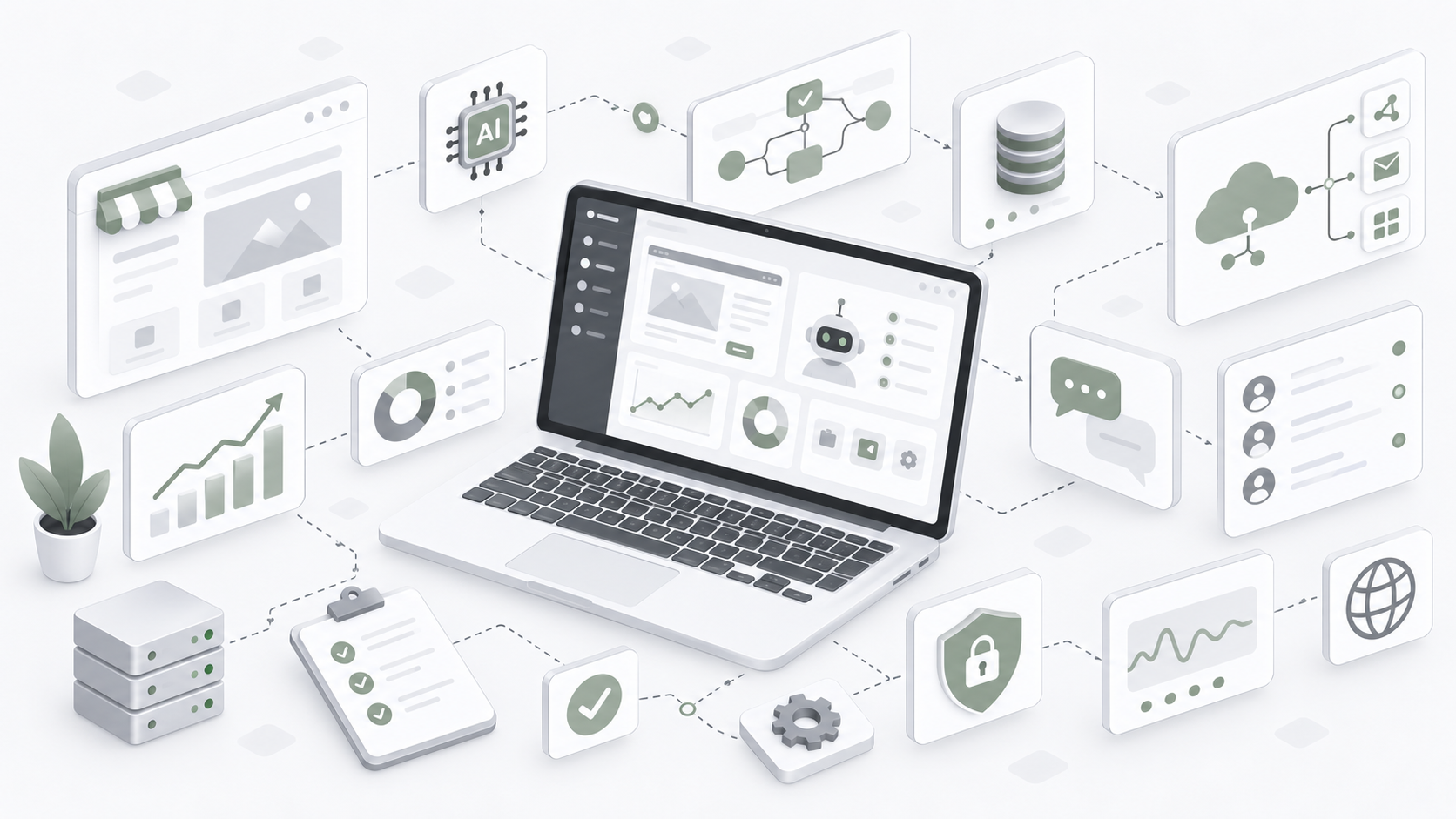
For a long time, the webmaster was the person who quietly kept a company’s digital presence working.
They maintained the website, fixed broken forms, updated content, dealt with hosting issues, connected services and made sure the business did not fall apart online.
The title largely disappeared as websites became easier to manage and responsibility spread across developers, marketers, IT teams and software platforms.
But artificial intelligence may be creating a new version of the same role.
Not a webmaster in the traditional sense, but a modern-day webmaster for the AI-led business: the person responsible for overseeing and maintaining the AI agents, automated workflows and connected systems that now sit across a company’s digital stack.
For business leaders, AI operations managers, automation architects, digital generalists and anyone stitching AI into day-to-day operations, this shift is practical, not theoretical. As more work moves into AI-powered tools and decision layers, someone has to supervise the system, keep a human in the loop, resolve failures, and make sure the AI operating layer supports the business now and in the future.
This article looks at how the webmaster role is evolving into AI operations management, how that operating layer is structured, which responsibilities sit with this role, and the skills needed to run it well.
From website manager to AI operations manager with AI tools
An AI-led business will not simply be a company where employees occasionally use artificial intelligence tools like ChatGPT or Claude.
It will increasingly contain workflows, automations and AI agents performing work that historically required people to move information between systems, research prospects, prepare reports, draft communications, update records and coordinate repetitive tasks, a future operating model for many businesses.
That creates a new problem.
Someone still has to make sure the whole thing works.
The modern role also manages AI integration and website visibility in AI-powered discovery systems and generative search engines.
Imagine a business where:
- an agent researches prospective customers
- another qualifies them
- an outreach agent prepares personalised communications
- workflows update the CRM automatically
- AI analyses campaign and sales performance
- support agents handle routine enquiries
- reporting is generated automatically
- internal agents retrieve information and perform administrative tasks
- webmasters oversee AI-driven tools like chatbots and content generators
- humans step in when judgement, approval or escalation is required
The business might have far fewer manual hand-offs than it once did.
But it has not become management-free.
It has simply created a new digital operating layer that somebody needs to supervise.
The human in the loop
This is where Human in the Loop, or HITL, becomes important.
AI agents should not necessarily be given unrestricted authority to perform every action.
There will still be points where a person should review, approve or intervene, using strategic thinking and human creativity where needed.
That might include:
- approving important communications and maintaining brand consistency across AI-generated content
- authorising financial actions
- dealing with unusual customer situations
- checking uncertain AI outputs, using critical thinking to evaluate AI-generated information
- handling failed workflows
- reviewing sensitive decisions
- changing agent permissions
- investigating incorrect data
- deciding when an automated process needs redesigning
The person responsible for those tasks starts to resemble the webmaster of the early web.
Except instead of maintaining a website, they are maintaining a network of digital workers, workflows and connected systems.
The AI operating layer and generative engine optimisation
Most businesses already have an established digital stack.
They may use a website, CRM, email platform, accounting system, analytics tools, project management software and dozens of specialist SaaS products.
AI does not necessarily replace that stack.
It sits above and between it, with deeper integration across existing search, analytics and content systems.
A modern AI architecture might include:
n8n for workflow automation and integration.
PydanticAI for building specialist agents.
LangGraph for more complex multi-agent systems.
Python for custom development.
APIs, webhooks and MCP for communication between systems.
Postgres or Supabase for persistent operational memory and data.
And AI models from companies such as OpenAI, Anthropic or others providing the reasoning and generation capabilities. AI tools can analyze vast volumes of search data and produce insights for SEO.
The existing business applications remain underneath. This operating layer can support AI SEO and Generative Engine Optimization (GEO) for AI search engines.
The goal is not to rip everything out and replace it with AI.
The goal is to create an intelligent operating layer across the systems the business already uses.
Someone has to own that layer
This is where many discussions about AI automation become unrealistic.
It is easy to draw a diagram showing ten agents automatically running a business.
The harder question is:
Who looks after them?
Agents will fail.
APIs will change.
Authentication tokens will expire.
Data will be incomplete.
Automations will encounter situations nobody anticipated.
Models will occasionally produce poor answers.
Business rules will change.
New systems will be introduced.
Someone therefore needs visibility across the entire environment, including search visibility and citation visibility.
Their job may include:
- monitoring agent activity
- reviewing logs and failures
- managing permissions
- improving prompts and instructions
- testing workflow changes
- supervising agent hand-offs
- maintaining integrations
- monitoring costs
- reviewing data quality with data analytics skills to interpret user behavior and conversion rates
- monitoring site speed and core web vitals
- deciding where HITL approval is required
- escalating exceptions to the right person
In a small business, one person might handle most of this.
In a larger organisation, the responsibilities will probably split across AI operations, automation, IT, security, data governance and business teams.
But the underlying function remains the same.
Someone needs to look after the machines that are increasingly doing the work, with operational reliability and citation visibility becoming a measurable strategic and SEO asset, and with speed still mattering across the stack.
The webmaster analogy
The analogy is not perfect, but it is useful.
Twenty-five years ago, businesses were told they needed a website.
Eventually, almost every organisation had one.
The website then became connected to databases, analytics, payment systems, marketing platforms and other business software, and today it also has to compete for visibility in traditional SEO and in AI-generated answers that sit alongside search listings.
The webmaster became less visible because the responsibility was absorbed into other roles.
AI may now be creating another similar transition. AI systems may cite useful content regardless of where it sits in traditional ranking positions.
Today, businesses are experimenting with individual AI tools, and being cited in those responses can still build visibility and authority even when it does not guarantee website traffic or drive traffic directly.
Tomorrow, those tools will increasingly become connected agents and automated processes.
Once that happens, companies will need people who understand how those systems fit together.
The modern-day webmaster will not spend their day uploading HTML files.
They may spend it watching dashboards showing what a collection of AI agents has been doing.
From using AI to becoming AI-first for competitive advantage
There is also an important maturity curve.
A business can be AI-assisted when employees use AI tools to help with individual tasks.
It becomes AI-integrated when AI is connected to workflows and business systems.
It becomes increasingly agentic when autonomous or semi-autonomous agents perform defined roles.
And eventually it may become genuinely AI-first when new processes are designed around the question:
Can AI handle, assist or coordinate this before we design a manual process?
At that point, AI is no longer optional as a productivity tool. As part of long-term strategy, traditional SEO focuses on rankings and clicks, but answer engine optimisation matters more as AI-generated answers compete with traditional search results.
It has become part of the operating model.
That makes the human oversight role even more important.
Humans do not disappear
An AI-led business should not be confused with a human-free business.
People will still provide judgement, creativity, commercial direction, forward thinking, relationships and accountability.
The difference is where humans spend their time.
Instead of repeatedly moving data between applications or performing predictable administrative tasks, people can increasingly supervise systems that do those things for them, including shaping digital experiences around individual user preferences in ways that improve user engagement and can increase conversion rates.
Humans become responsible for direction, exceptions and decisions.
AI handles more of the repeatable execution, and under human direction that personalization can further increase engagement and conversion rates.
That makes HITL less of a temporary safeguard and more of a permanent part of the architecture.
A new type of digital generalist
The person occupying this role may need an unusual combination of skills.
They will need enough technical knowledge to understand APIs, automation, data and AI agents.
But they will also need to understand the business itself. That includes understanding user intent and the industry context behind what people search for.
A technically perfect automation that misunderstands the commercial process is still a bad automation.
That means the role may favour digital generalists who understand websites, marketing, CRM systems, analytics, search, content strategy, automation and business operations.
They do not necessarily need to build every component themselves. They should also identify content gaps, address content gaps across key pages, and use clear structure, because explanatory content such as how-to guides is more likely to be cited by AI systems, content structure matters more than length, and regular content updates improve citation chances as content freshness influences citation likelihood.
But they need to understand how the components interact.
That is remarkably similar to the role the early webmaster once played.
They were often the person who understood enough about every part of the web stack to keep everything connected.
The scope has simply become much larger.
The modern-day webmaster in an AI web design agency
The term may never return.
We may instead talk about AI operations managers, agent supervisors, automation architects or AI systems operators, especially inside an AI-powered digital agency or modern digital agency model.
But the underlying need is becoming clearer.
As businesses move from using individual AI tools to running connected AI workflows and multiple agents, somebody will need responsibility for the layer that ties everything together. In practice, that can cut task completion time from hours to minutes and let teams serve more clients without increasing workload.
They will monitor it.
Improve it.
Intervene when necessary.
And make sure the technology continues serving the business rather than the other way around.
Twenty-five years ago, that person looked after the website. In AI-powered web design and AI web design work, code generation can reduce web development time by 40%, and AI tools can produce design variations in days, not weeks.
In the AI-led business, they may end up looking after a digital workforce.