Agent technology is often described using dramatic language, but the rise of the digital PA and the one person AI business is really a structural shift: artificial intelligence is giving solo operators, entrepreneurs and one-person business owners a highly capable digital personal assistant that handles routine operational work so the human can focus on judgment, quality and client relationships.
We hear about AI employees, autonomous departments and digital workforces. For most people building a business without a large organization, company or team, a simpler description is more useful:
a highly capable digital personal assistant.
Tools such as Hermes are best understood as an operational layer that can monitor, organise, prepare and coordinate digital work. That makes this a significant trend in modern entrepreneurship and a practical reality for a new generation of founders, startups and new companies that want leaner ways to operate in a changing economy. In the sections that follow, we look at what a digital PA can actually do, how it differs from automation, why narrow AI systems often work better than general automation, what one-person AI-enabled businesses look like in the real world, where human dependency creates risk, and how work shifts in this era as AI takes over the legwork surrounding the professional’s decisions rather than replacing the professional.
What a digital PA using AI tools might do
A digital PA marks a significant shift in artificial intelligence, turning narrow tools into practical business support with the ability to handle routine work across connected systems. In this model, one person can build lean operations around AI-enabled support, a broader trend now shaping entrepreneurship, startups, and new companies. The digital personal assistant is no longer a sci-fi idea but a real and useful concept for people who want a clear path to run better workflows with modern software.
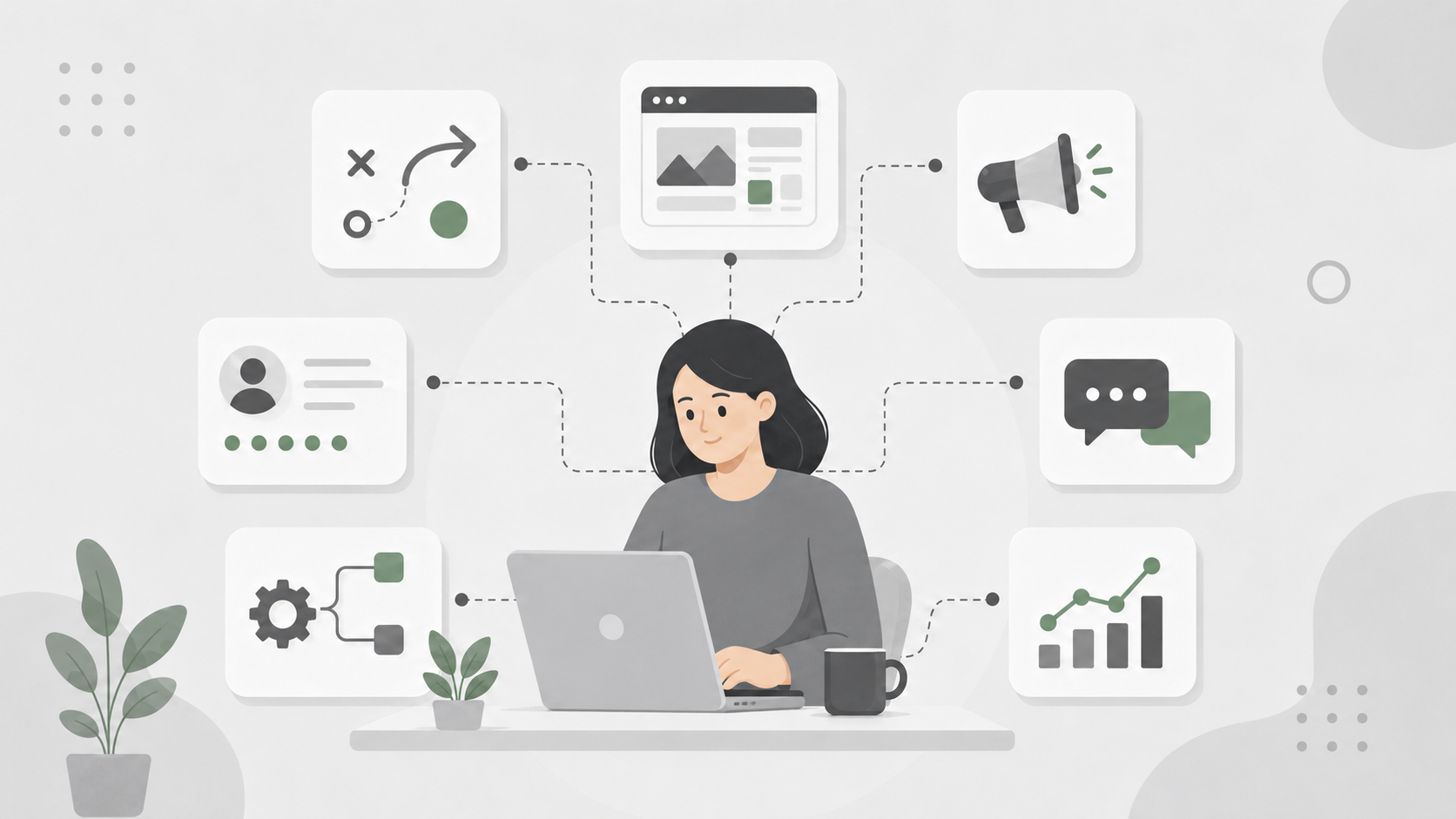
A digital PA could:
- monitor emails and dashboards with focus;
- prepare meeting briefs;
- organise files;
- summarise conversations, including relevant sounds where captured;
- maintain routine CRM records;
- draft standard communications;
- check whether automations completed and act on exceptions;
- gather analytics;
- assemble reports;
- surface exceptions;
- schedule approved work.
Instead of the operator checking eight platforms, the agent brings the important changes to them. After the Hermes sentence, it is worth noting that computing is moving toward invisible background operations, and digital personal assistants are evolving into proactive cognitive partners across the economy.
Instead of manually preparing for a client meeting, the agent gathers recent activity, open tasks, performance changes and outstanding decisions, helping a solo business scale efficiently.
The person still interprets the evidence and leads the relationship, but a new generation of entrepreneurs can build companies that scale across the world while most people still picture growth as hiring traditional teams.
Digital PA versus automation
A digital PA is not the same as a fixed automation.
A digital PA could act across software, operations, and decision paths rather than just complete isolated tasks.
Automation follows defined instructions:
When a form is submitted, create a CRM record and notify the owner.
An agent deals with a less predictable situation:
Review the new enquiries, identify which appear urgent, gather relevant background and prepare recommended next actions.
The strongest system combines both.
Automation handles stable plumbing.
The agent handles interpretation and coordination. Modern assistants can handle complex workflows through multi-step task execution autonomously and anticipate needs along a defined path.
Instead of the operator checking eight platforms, these AI tools can retain user context and preferences over time, which improves resource allocation and helps people leverage AI without losing focus.
In meeting preparation, artificial intelligence can assemble context from text, voice, images, and sounds, though there are still challenges around accuracy, privacy, and review.
The human still leads the relationship and responsibility, while the system helps build processes that can scale efficiently.
The one-person company agent business
There is a genuine opportunity for one person to run a highly efficient business supported by agents and automation, and that is the core of the one person company model now attracting a growing pool of interest from solo founders, investors, and AI-first startups.
However, this model is most convincing when it solves a narrow and repeatable problem, because many new companies now launch with a simple idea, then build around clear customer pain rather than broad ambition.
Examples might include:
- Local SEO monitoring;
- review management;
- tender preparation;
- lead qualification;
- catalogue enrichment;
- recurring reporting;
- compliance checking.
A decade ago, trying to do this alone usually meant hiring help across operations, content, and media before you could even sell consistently or prove revenue.
These businesses often begin as services, and many reach their first year with real momentum because AI adoption has lowered the cost of delivery while increasing the speed at which they can create value.
The human performs much of the work manually, then develops a repeatable process that supports sales and improves the odds of success.
Over time, agents handle more of the routine activity and the human focuses on exceptions, quality and clients.
The business gradually becomes a managed SaaS or productised service, using systems that still need human review because artificial intelligence can make mistakes, especially when context is unclear or edge cases appear. The most resilient operators combine automation, agents, and human judgement to leverage AI without losing accuracy.
Why this works better than an autonomous general agency
A one person company opportunity, supported by artificial intelligence and automation, benefits from:
- structured inputs;
- predictable outputs;
- clear quality criteria;
- repeatable workflows;
- limited exceptions.
A decade ago, building even a small content or media operation usually needed multiple employees.
A general marketing agency faces far more ambiguity.
Each client has different:
- priorities;
- customers;
- offers;
- constraints;
- risks;
- politics;
- capabilities.
That makes full automation much less credible, especially as barriers continue to fall across industries.
An agent can monitor rankings consistently. It is much harder for it to determine the right commercial strategy for dozens of unrelated SMEs in every sector, where the main challenges vary and strategic focus matters.
For solo founders, the key is often not a novel idea but execution, customer relationships, and a narrow offer that can build value and sales.
These businesses often begin as services, then use systems to scale into media, software, or managed delivery; in one case, a solo founder used AI to produce 20 blog posts monthly. In the U.S., there are 29.8 million solopreneurs, 56% launched since 2020, and 77% are profitable in their first year.
AI adoption among solopreneurs reached 74% as of 2026, which helps explain why more founders and backers are paying attention to solo-led startups. From there, the best models can grow into managed SaaS or a productised service with stronger revenue traction, and solo-led companies represented 30% of all startups in 2024.
The single point of failure
The major weakness remains the human owner, and the scale of agent workflows varies by industry, sector, and the underlying operations.
What happens when they are sick or go on holiday?
AI can continue routine monitoring and approved activity, but it cannot fully replace:
- client reassurance;
- sensitive decisions;
- negotiation;
- unusual problem solving;
- strategic accountability.
A resilient one-person business therefore needs more than agents.
It needs:
- documented processes;
- portable data;
- emergency permissions;
- automatic status communications;
- clear pause rules;
- trusted backup specialists;
- a contingency plan.
As AI tools make product development easier and barriers fall, distribution becomes harder, the competitive landscape intensifies, and new challenges emerge.
The business is not truly one person plus AI.
It is better described as:
one accountable operator, supported by AI, automation, specialist tools, integrated systems and a small human contingency network within a lean organization, where similar capabilities are now widely available across businesses, so focus, execution, and customer relationships matter even more when AI can handle more routine work.
A different kind of working day to leverage AI
The one-person AI-enabled business may spend much less time on:
- administration;
- reporting;
- routine research;
- scheduling;
- record maintenance;
- repeated formatting.
That creates more time for:
- clients;
- judgement;
- product improvement;
- strategy;
- relationships;
- exception handling.
This is a substantial change, and recently it has sharpened the need for clear focus on what the owner should automate versus what still needs human judgement.
But it should not be confused with the disappearance of human work.
The operator becomes less of a production machine and more of a system designer, supervisor and decision-maker who can build practical systems that scale efficiently.
If current projections hold, freelancers could make up half of the U.S. workforce by 2027, which makes this shift a realistic path for more independent businesses.
The major weakness remains the human owner, and the organization also faces security, governance, and privacy challenges as assistants gain access to more operations, systems, and shared data.